A field guide to Irish turf
Móin: the fuel, the bog and the people
Turf has warmed Irish homes for centuries and shaped a fifth of the country’s land. This is a plain reference to what it is, how it was cut and saved, and where it stands now.
Chapter 1
i.What turf is, and how bogs formed
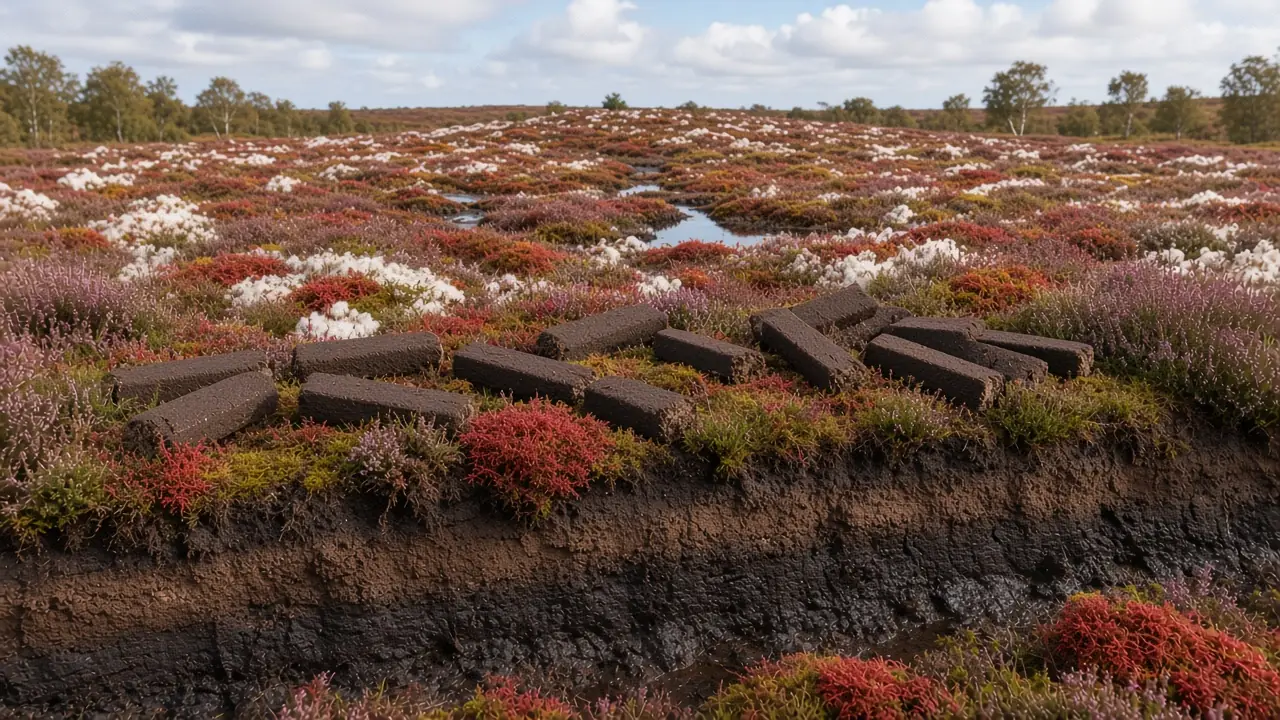
Peat is plant matter that never finished rotting. In waterlogged ground there is too little oxygen for decay, so dead bog moss (Sphagnum), sedges and heathers pile up year on year. Undisturbed peat is 88% to 97% water.2
When the ice retreated about 10,000 years ago, it left shallow lakes across the midlands. Reeds and fen plants filled them in. Eventually the peat grew above the groundwater, so the bog was fed only by rain and became the acid, moss-covered dome we call a raised bog.2,6
The deep peat grows at roughly a millimetre a year. Cut a turf bank and you are looking at a few thousand years of the bog’s history.2
Chapter 2
ii.Raised and blanket bogs
| Topic | Raised bog | Blanket bog |
|---|---|---|
| Where | Midlands, in old lake basins | West coast and uplands |
| Rainfall | Under ~1,250 mm a year | Over ~1,250 mm, spread through the year |
| Age | From ~10,000 years ago | Mostly ~7,000 to 4,000 years ago |
| Depth | Typically 3 to 10 m | Thinner, draped over the land |
| Original area | ~311,000 ha | ~774,000 ha |
Chapter 3
iii.Turbary: the right to cut
A family’s bank was often not on their own land. The right of turbary is the right of digging, cutting and taking away turf from bog-land for fuel, along with preparing and storing it there, and it can arise by custom.8 Rights were often handed down with the farm. How a particular right passes on is a question for the title, not a single rule on this page.
Irish law still defines the right in those terms, and it is central to the rules on turf today.
Chapter 4
iv.Cutting and saving turf
Turf was cut in spring with the sleán, the winged turf spade. Its narrow blade has a second wing at right angles on one side, so each stroke cuts two faces of a long, oblong sod from the bank face. Ó Dónaill records sleán as a turf-spade or slane, and a sleán uchta, or breast-slane.16 One person cut while another caught and threw the sods out onto the bank, and a barrow carried them off to spread.
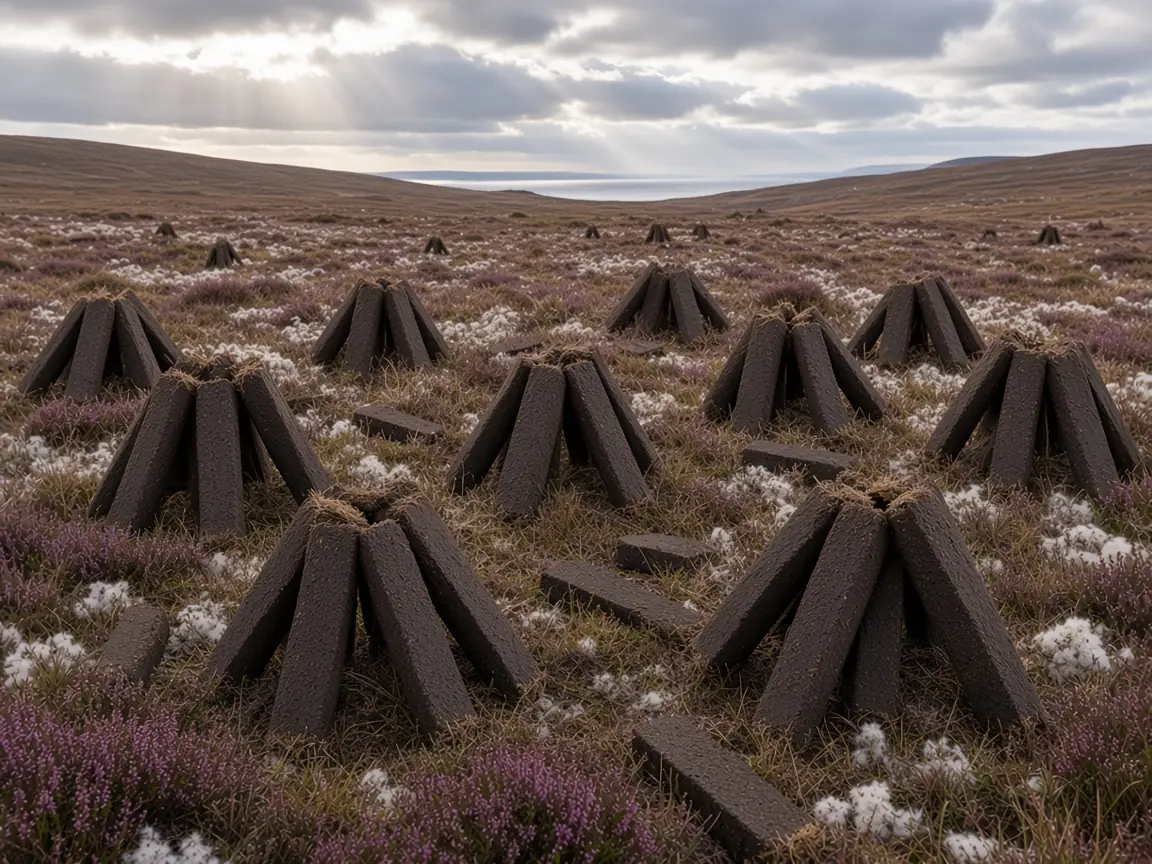
Then came the slow part, which people called “saving” the turf. The sods were left to skin over, then footed (gróigeadh): stood on end in small leaning clusters so the wind could get through. Later they were re-footed, gathered into clamps, and finally drawn home by cart, creel or tractor to build the reek.16,17
Chapter 5
v.Turf in the home
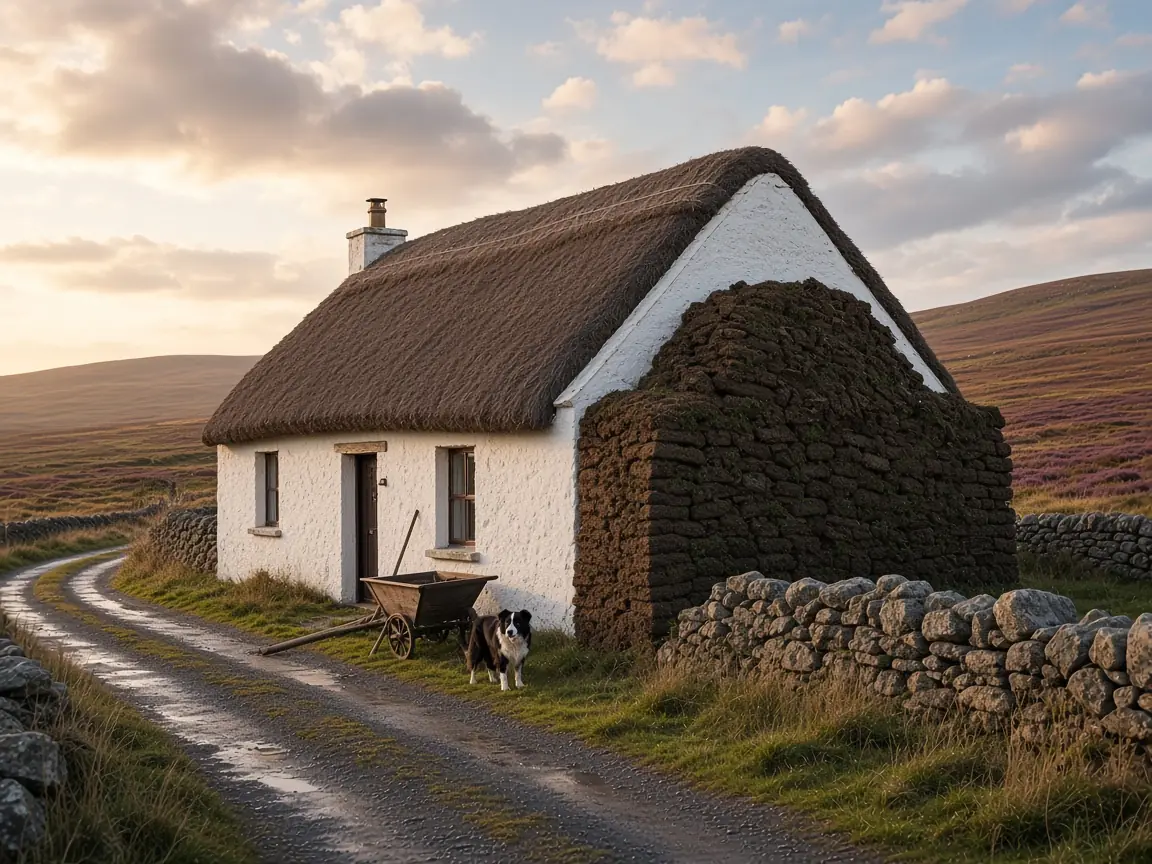
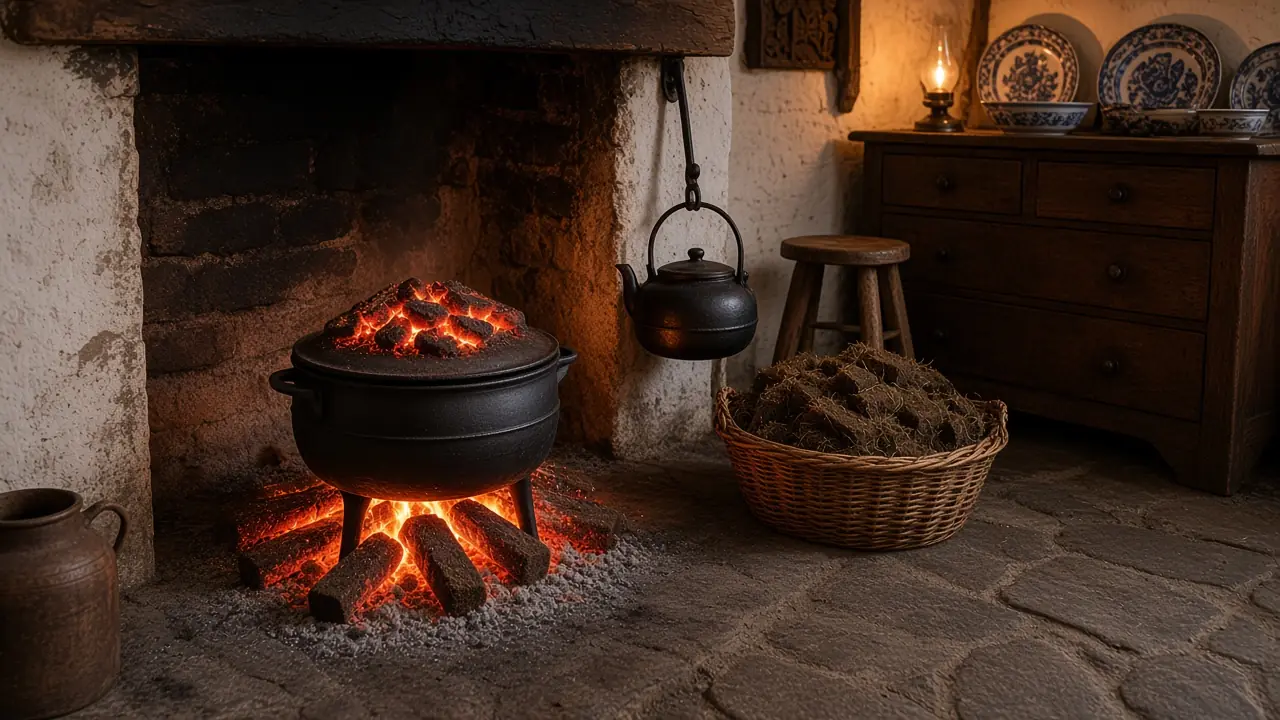
In most rural houses the turf fire was the kitchen. It burned on a flat hearth at floor level and was rarely let go out. At night it was raked over with ashes, and in the morning the gríosach (embers) was blown back to life.
Bread was baked in the pot oven or bastable, an iron pot set in the embers with more hot turf heaped on its lid. A crane swung the kettle and pots over the heat.
In the evening neighbours gathered at certain houses, the rambling houses, for stories, songs and cards around the fire. Thousands of these memories were written down by schoolchildren in the 1930s for the Schools’ Collection, now searchable on Dúchas.17
Chapter 6
vi.Industrial turf
The new State saw the bogs as a home-grown energy source. The Turf Development Board was set up in 1934, and in 1946 it became Bord na Móna.12,11 The first plan called for 24 bogs producing over a million tonnes of sod peat a year, and turf-fired ESB power stations.12
For decades milled peat from the midland bogs fed power stations, briquette factories and horticulture. That era is over. Lough Ree, the last peat-fired ESB station, stopped in December 2020, and Bord na Móna formally ended peat harvesting on 15 January 2021.14,13
A short timeline
- c. 8000 BCRaised bogs begin forming in midland lakes.2
- 148/147 BCThe oak Corlea trackway is laid across a Longford bog.15
- 1934Turf Development Board formed.12
- 1946Turf Development Act creates Bord na Móna.11
- 2011Compensation scheme for the end of cutting on protected raised bogs.4
- Dec 2020Last peat-fired ESB stations close.14
- Jan 2021Bord na Móna ends peat harvesting.13
- Oct 2022Retail and online sale of turf is restricted under the Solid Fuel Regulations.8
Chapter 7
vii.The rules today
Selling turf. Since 31 October 2022, the regulations restrict the sale of turf from shops, garages, fuel yards, pubs and other public places, and by way of the internet or other media. People with turbary rights can still cut for their own use, share it, and sell to others other than in those ways. The rules are about sale and distribution, not a plain ban on burning turf a household already has.8,9
Protected bogs. Domestic cutting has been restricted on the 53 raised bog Special Areas of Conservation and 36 raised bog Natural Heritage Areas. Affected landowners and rights holders could apply to the Cessation of Turf Cutting Compensation Scheme.4
This page is a general guide, not legal advice. Check with your local authority or NPWS about a particular bog.
Chapter 8
viii.Bogs and climate
Irish peatlands store an estimated 1,566 million tonnes of carbon, about 64% of all the carbon in the country’s soils.1 A living bog keeps drawing CO₂ down. Once drained or cut, the peat dries and that carbon leaks back out.1,7
Restoring bogs means blocking drains and raising the water table again, so bog moss can grow and the peat stays wet.3
Chapter 9
ix.Turf words in Irish
A small glossary, with meanings from Ó Dónaill’s dictionary.16
- móin
- Turf, peat. Also bogland, moor.
- fód móna
- A sod of turf. Fód is a sod.
- caorán
- A fragment or small sod of turf. Also moor.
- portach
- A bog, a peat-bog. Also a turf-bank.
- sleán
- Turf-spade, slane. Sleán uchta, breast-slane.
- gróigeadh
- Footing of turf; also footed turf.
- cruach mhóna
- A stack, rick or clamp of turf.
- cliabh
- A creel, or a pannier basket.
- gríosach
- Hot ashes, embers.
- meitheal
- A working party. Meitheal mhóna, a band of turf-cutters.
Chapter 10
x.Turf FAQ
Is turf the same as peat?
Yes. Peat is the material: partly decayed plant matter, mostly bog moss, built up in waterlogged ground. In Ireland, “turf” usually means peat cut and dried for fuel. In Irish, móin covers both.2,16
How long did a bog take to form?
Raised bogs began forming in shallow lakes and hollows at the end of the last Ice Age, about 10,000 years ago. Most blanket bog is younger and spread from about 7,000 to 4,000 years ago, when the climate grew wetter.2,5
How fast does peat grow?
Very slowly. The deep peat layer builds up at roughly 1 mm a year, so a metre of turf bank can hold about a thousand years.2
How deep are Irish bogs?
Most Irish raised bogs are described in this guide’s restoration source as 3 to 10 metres deep. Clara Bog in Offaly is about 10 metres. The reserve’s own account also gives a higher average, 9 to 12 metres, for raised-bog peat.3,6
What is the difference between a raised bog and a blanket bog?
Raised bogs are domed, deep and mainly in the midlands, where rainfall is lower, under about 1,200 to 1,250 mm a year. Blanket bogs are thinner and drape over hills and lowlands in the wet west and the uplands, where rainfall is higher and spread through the year.3,5,6
How much of Ireland is bog?
Peat soils cover around 21% of the land of the State. The original area of raised bog was about 311,000 hectares and of blanket bog about 774,000 hectares. Only about 10% of the original raised bog and 28% of the original blanket peatland are still thought suitable for conservation.1
What is a right of turbary?
In the 2022 Solid Fuel Regulations it is the right of digging, cutting and taking away turf from bog-land for use as fuel. It includes a right arising by custom, and the right of preparing and storing on the bog any turf cut from it. Many families hold turbary on bog they do not own.8
What is a sleán?
A sleán is the Irish turf spade. Ó Dónaill gives “turf-spade, slane”, and also sleán uchta, the breast-slane. The tool used on the bank has a narrow blade with a wing set at right angles along one side, on a long shaft, so one stroke cuts two faces of the sod.16
What does “footing” turf mean?
Footing (Irish gróigeadh) is standing the half-dry sods on end in small clusters so wind can get through them. Ó Dónaill glosses the word as the footing of turf, and as footed turf. The sods are often re-footed or gathered into larger clamps before they come home.16
How long does turf take to dry?
Usually the whole summer. Turf is cut in spring, spread, footed and turned, and brought home dry in late summer or autumn. A wet year can leave it on the bog much longer. That timing is the ordinary account in the Schools’ Collection, not a single measured trial.17
How much water is in a wet sod?
A lot. Undisturbed peat is about 88% to 97% water, which is why fresh sods are heavy and shrink so much as they dry.2
How much heat does turf give?
SEAI puts sod peat at about 13.1 MJ per kg. That is roughly the same as seasoned logs (13.1) and about half of coal (27.8). Peat briquettes give about 18.6.10
Can you still cut turf in Ireland?
On many bogs, people who hold turbary rights have continued to cut for their own use. Cutting has been restricted on the 53 raised bog Special Areas of Conservation, and on 36 raised bog Natural Heritage Areas, and affected owners and rights holders could apply for compensation. Whether a particular bank is still open has to be checked with NPWS. This is a general guide, not legal advice.4
Can you buy or sell turf?
Since 31 October 2022 the Solid Fuel Regulations have restricted how turf may be sold. As they are drafted, turf is not to be retailed or distributed for home heating in the ordinary way, and a turbary holder may sell it only if the sale is not by way of the internet or other media, and not from a shop, garage, filling station, fuel yard, pub or other public place. Giving turf away for personal use is treated separately. The regulations are about sale and distribution. They do not, in terms, say that a household may not burn turf it already has. This is a general guide, not legal advice.8,9
Is this the same as the smoky coal ban?
It belongs to the same regulations. S.I. No. 529/2022 sets national standards for solid fuel sold for heating, including smoky coal, turf and wet wood, with cleaner air as the aim. The turf rules are mainly about sale, sharing and where a sale may take place, which is not the same test as the smoke limit set for coal. This is a general guide, not legal advice.9,8
Does Bord na Móna still harvest peat?
No. Its last full harvest was in 2018, with a partial harvest in 2019 and a suspension in 2020. It formally ended all peat harvesting on its lands on 15 January 2021.13
When did the turf power stations close?
RTÉ reported on 18 December 2020 that Lough Ree Power at Lanesborough, described as the last peat-burning ESB station, was ceasing production that day after 62 years. The same closing fortnight took in West Offaly Power at Shannonbridge, which this guide records as stopping on 11 December 2020.14
Why are bogs important for the climate?
Irish peatlands store an estimated 1,566 million tonnes of carbon, about 64% of the country’s soil organic carbon. Draining or cutting the bog stops that slow storage and turns the peat into a source of carbon dioxide. Rewetting can slow the loss.1,7
Why do things survive in bogs?
Waterlogged peat has almost no oxygen, so decay nearly stops. Wood, cloth, seeds and even skin and hair can survive for thousands of years.2
What is the oldest road found in a bog?
The Corlea trackway in Co. Longford is an Iron Age road of oak planks over 1 km long. Tree rings date it to 148/147 BC.15
What does turf smell like?
Turf smoke is sweet, earthy and a little like whiskey. For many people it is the smell of a country kitchen in winter. It is the one thing on this list you cannot look up in the sources.
Smell it at home
No fire, no bog, no bother
If you miss the smell of a turf fire, small sods of turf incense on a slate bring it indoors. They’re handmade in South Armagh by Aureal Turf Incense.
Sources
The seventeen sources the chapters rest on. A few later notes, used only on the longer pages, are listed on the sources page.
- NPWS, National Peatlands Strategy (2015)
- NPWS, National Raised Bog SACs Management Plan 2017–2022
- NPWS, Best Practice in Raised Bog Restoration (Irish Wildlife Manual 99)
- NPWS, Cessation of Turf Cutting Compensation Scheme
- Irish Peatland Conservation Council, Blanket bogs factsheet
- Clara Bog Nature Reserve, How bogs form
- EPA, Ireland’s Environment 2020, Chapter 5: Land and Soil
- S.I. No. 529/2022, Air Pollution Act 1987 (Solid Fuels) Regulations 2022
- gov.ie, New Solid Fuel Regulations signed (2022)
- SEAI, Conversion factors (net calorific values)
- Turf Development Act, 1946
- Bord na Móna Living History, A brief history of the peat industry in Ireland
- RTÉ, Bord na Móna formally ends peat harvesting (15 Jan 2021)
- RTÉ, Last peat power station ceasing production (18 Dec 2020)
- Heritage Council, Peatland Archaeology
- Ó Dónaill, Foclóir Gaeilge–Béarla, at teanglann.ie
- Dúchas.ie, the National Folklore Collection (Schools’ Collection)
More on the smell and memory of turf: irishincense.com.